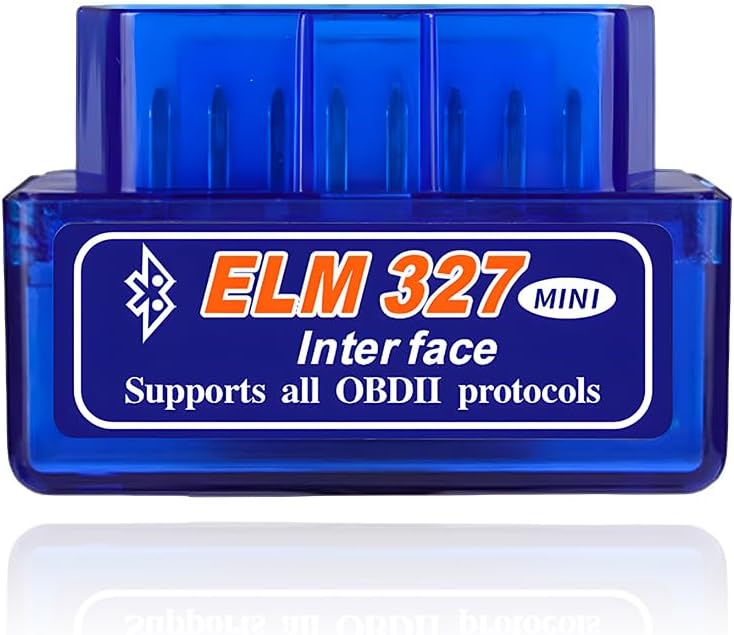
- Classic Bluetooth, PIN pairing
- Android phones and tablets
- Torque, Car Scanner, OBD Fusion
A Bluetooth mini meant for the big screen in the dash: pair it with an Android head unit, run Torque on the stereo, and keep the phone free for navigation and calls.
An Android head unit is a tablet bolted into the dash, and it can run the same OBD apps as a phone. Pair it with a Bluetooth ELM327 mini and Torque's gauges live on the stereo screen for good. The phone stays free for maps and calls, and nothing needs launching before a drive.
This family is two dongles sold for exactly that job. JOYING, a maker of Android car stereos, sells an ELM327 V2.1 Bluetooth mini with PIN 1234 and a two-year warranty. SYGAV sells a mini ELM327 for Android head units and states that it is matched to the head units it sells, with no iOS support.
Why a dedicated head-unit mini at all? Some branded phone minis steer away from stereos. Veepeak, for one, says Android head units are not recommended for its VP11 and may not be supported. Head units often handle Bluetooth through their own module and app rather than stock Android, and a dongle sold by the stereo maker has the best chance of pairing on the first try.
What a dash-mounted setup gives you:
If the dash screen is not the goal, the phone minis on the ELM327 mini app setup notes cover the same apps on a handset.
| Spec | Value |
|---|---|
| Version | ELM327 V2.1 (JOYING) |
| Connection | Bluetooth |
| Bluetooth PIN | 1234 |
| Range | 5–10 m (16.4–32.8 ft) |
| Current draw | 45 mA |
| Operating voltage | 12 V |
| Serial rate | 38400 (printed as 38400Hz) |
| Weight | 23 g; 48 g packaged |
| Designed for | Android head units and car stereos |
| iPhone / iOS | Not supported |
| Protocols (SYGAV) | ISO 9141-2, ISO 14230-4 KWP (5-baud and fast init), ISO 15765-4 CAN (11/29-bit, 500/250 kbaud) |
| Functions | Read and clear codes with meaning, turn off the MIL, current sensor data |
| Code library (SYGAV) | Over 3,000 generic code definitions |
| Live data | RPM, load, coolant and intake temp, speed, fuel trims, manifold pressure, timing, air flow, throttle, O2, fuel pressure |
| In the box (SYGAV) | Mini ELM327 Bluetooth dongle, CD driver |
| Warranty (JOYING) | 2 years |
Pairing a mini to a stereo follows the phone routine with one twist: the search usually starts in the head unit's own Bluetooth app, not in Android settings. Many Android stereos keep a separate Bluetooth module for calls and music, and that app is where it lets you add other devices.
The JOYING mini quotes a Bluetooth range of 5 to 10 metres, far more than the gap between port and dash. Range problems here usually mean a pairing that went to the wrong module, not distance.
Things that trip up head-unit setups:
Once paired, most owners set Torque as a floating widget or a split-screen panel beside the map, depending on what the stereo allows.
JOYING prints the figures that count for a dongle left permanently in the socket: 45 mA of current at 12 V, 23 g of weight, a range quoted at 5 to 10 metres and PIN 1234. It also lists a 38400 serial rate, printed on the spec as 38400Hz, which is the speed the ELM327 talks at internally.
The 45 mA figure deserves a moment. If the car keeps the OBD port powered with the ignition off, as many do, the mini draws about 1.1 Ah a day. On a car driven every day the next trip puts that back, but a car left for two weeks loses a noticeable share of a small battery. Pull the mini when the car will sit, or fit it to a car whose port switches off with the ignition.
The SYGAV version lists its protocols in full, and there are seven:
SAE J1850 PWM and VPW are missing from that list. Those buses appear mainly on older US Fords and GM cars from before CAN became mandatory for the 2008 model year. On a CAN car, which covers most cars built since, the gap does not matter.
What both minis read:
Both dongles aim at the same stereo screen, and the choice comes down to the brand of your head unit and the age of your car. When the stereo is neither brand, a phone mini on a dash mount is the fallback worth weighing.
| JOYING | SYGAV | |
|---|---|---|
| Version | ELM327 V2.1 | Mini ELM327 |
| PIN | 1234 | Not stated |
| Protocols listed | Not listed | 7, CAN and KWP |
| Extras | 2-year warranty | CD driver |
| iOS | No | No |
A quick way to decide:
Neither mini changes what the dash can diagnose. Both read generic engine data only, so ABS, airbag and transmission warnings stay out of reach whichever you fit. The gain is convenience: gauges that are simply there every drive, on a screen already in your line of sight, with no phone to mount, unlock and connect first.
No Android stereo at all? A phone in a dash mount does the same job. The blue ELM327 mini is the budget Android pick with the same PIN, and the ViaBecs Bluetooth 5.1 mini covers iPhones. Before ordering a head-unit mini, confirm the stereo installs Android apps and has a Bluetooth menu that can add devices other than phones.
It is sold for Android stereos and both versions are standard Bluetooth ELM327 minis. SYGAV matches its unit to its own head units, so check that your stereo can add non-phone Bluetooth devices.
1234, as printed in JOYING's specification.
It draws 45 mA. On a car whose port stays live, that is about 1.1 Ah a day, so pull it before the car stands unused for weeks.
Not through projection. The head unit needs to run full Android so Torque or Car Scanner can be installed on it.
It lists CAN, KWP and ISO 9141-2 only, without J1850 PWM or VPW, so older US Fords and GM cars on J1850 may not connect.